Repeatability
How often does the task recur, and does it always run the same way?
The Ollyn method
Our method never starts from a tool. It starts from the real work, task by task, and picks the simplest answer that lasts for each one. Here is how it works, and what it produced in the field.
When we leave, your business is not the same.
Discuss a perimeter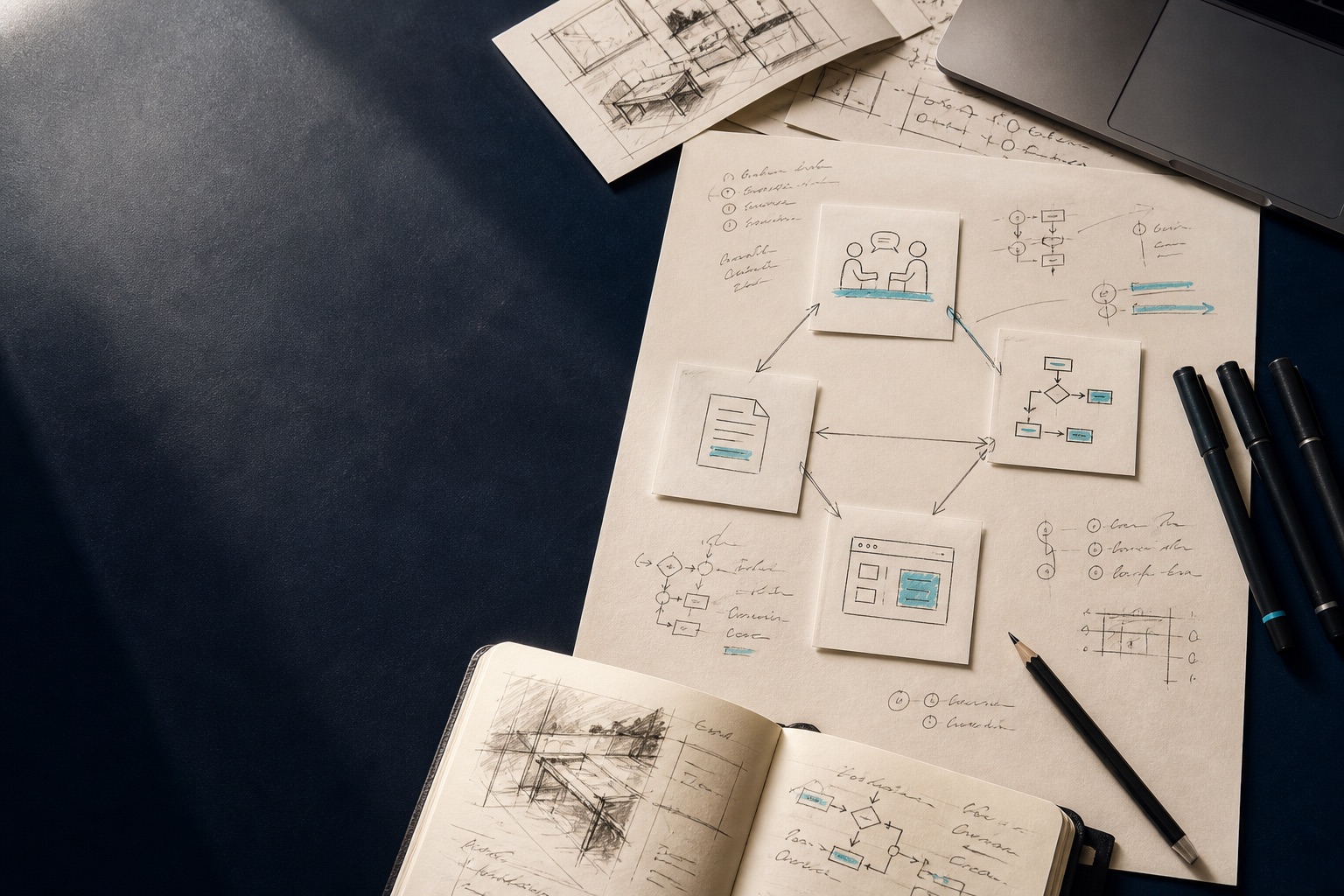
Our approach
An Ollyn transformation has a start and an end. We arrive, do the work with your teams, then leave you autonomous.
In practice
We frame a precise scope with you (a department, a process) and settle in alongside the teams.
You get
An agreed scope, identified contacts, a schedule.
In practice
We spend time with your teams while they work. Each person lists their tasks over a few days.
You get
The raw list of the scope's real tasks, not those of the theoretical process.
In practice
We connect the tasks (who does what, with which data, tools and lead times), then score each one on four criteria to choose an answer.
You get
A map of flows and friction points, and a decision matrix: one decision per task, with its reasoning.
In practice
We put the chosen answer in place, starting with the best impact-to-effort ratio. Then we measure: time saved, reliability, adoption.
You get
Workflows, integrations, tools or process changes in production, with simple indicators.
In practice
We train your teams to use what was put in place, on your tools and your real cases.
See our training programsYou get
Teams who know how to use the changes without us.
In practice
We give you what you need to carry on alone: documentation, decision rules, access.
You get
A complete handover file.
In practice
We leave. What was put in place keeps running without us.
You get
An organisation that runs without depending on Ollyn.
When we leave, your business is not the same.
The heart of the trade-off
We don’t decide a transformation “in general”. We decide task by task, with the same grid every time.
How often does the task recur, and does it always run the same way?
How many edge cases, exceptions and implicit rules does the task contain?
What does a person bring that nothing else can: judgment, relationship, responsibility?
Is the task deterministic enough to be made reliable by a tool or a model?
Four possible answers
Human
The task stays human, but we prepare it, track it and strip out what weighs it down.
Running a candidate interview.
Automation / no-code
A sequence of actions triggered automatically, with little or no code.
Issuing and sending a contract.
Custom business software
A real tool when the process is structural and built to last.
Bringing functions into an internal tool.
AI in the workflow
A model inserted at a precise point of the flow, with human control on the output.
Rewriting and anonymising a listing.
Case study: a recruitment firm
Over two years, inside a recruitment firm, Ollyn transformed the operations: making the work more efficient and the organisation easier to evolve. The starting point was a five-day inventory, around 30 to 40 tasks, then one decision for each.
| Task | Decision | What was put in place |
|---|---|---|
| Run a candidate interview | Human | The interview stays human; it is better prepared and tracked. |
| Prepare and send a contract | Automation | An issuing and sending workflow that removes repeated handling. |
| Run a recurring business function | Business software | The function built into Mediirect, the software made for their operations, rather than another tool. |
| Rewrite and anonymise a listing | AI in the workflow | A model inserted into the publishing flow, with human review. |
Outcome: not an AI layer on top of the existing system, but a clearer organisation of work and better-placed tools.
At the end of the diagnostic
Tasks, owners, inputs, outputs and friction points in a targeted perimeter.
For every task: human, automation, business software or AI, with the reason for the choice.
Actions ranked by impact, effort, dependencies and delivery sequence.
What can start now, what needs framing, what should not be automated.
Engagement formats
Observe a perimeter, make the trade-offs, produce the roadmap. The best way in.
Take a perimeter in hand: deploying automation, AI and integrations, change management.
Design and deliver the business software, connectors or workflows no off-the-shelf tool covers.
The handover and training of your teams can, depending on the project and eligibility, be funded by an OPCO, through a partner organisation certified Qualiopi. The diagnostic and tool development are the subject of a separate proposal. Discover the action training
Get started
A first conversation to frame an activity, its tasks and what a short diagnostic could unlock.
Request a diagnostic